
Sunday Worship8, 9:30 and 11 am
While working as the director of a preschool, I would get kids out of the car for morning drop-off. Many times, even before saying hello, their first comment to me, as they beamed with excitement, would be “look at my new shoes” or they would just wiggle them in my face until I noticed. Above all other pieces of clothing, shoes were the biggest thing to show off. As a teacher, I then had to walk the balance of meeting their happiness without emphasizing that their self-worth was tied to something new and shiny.
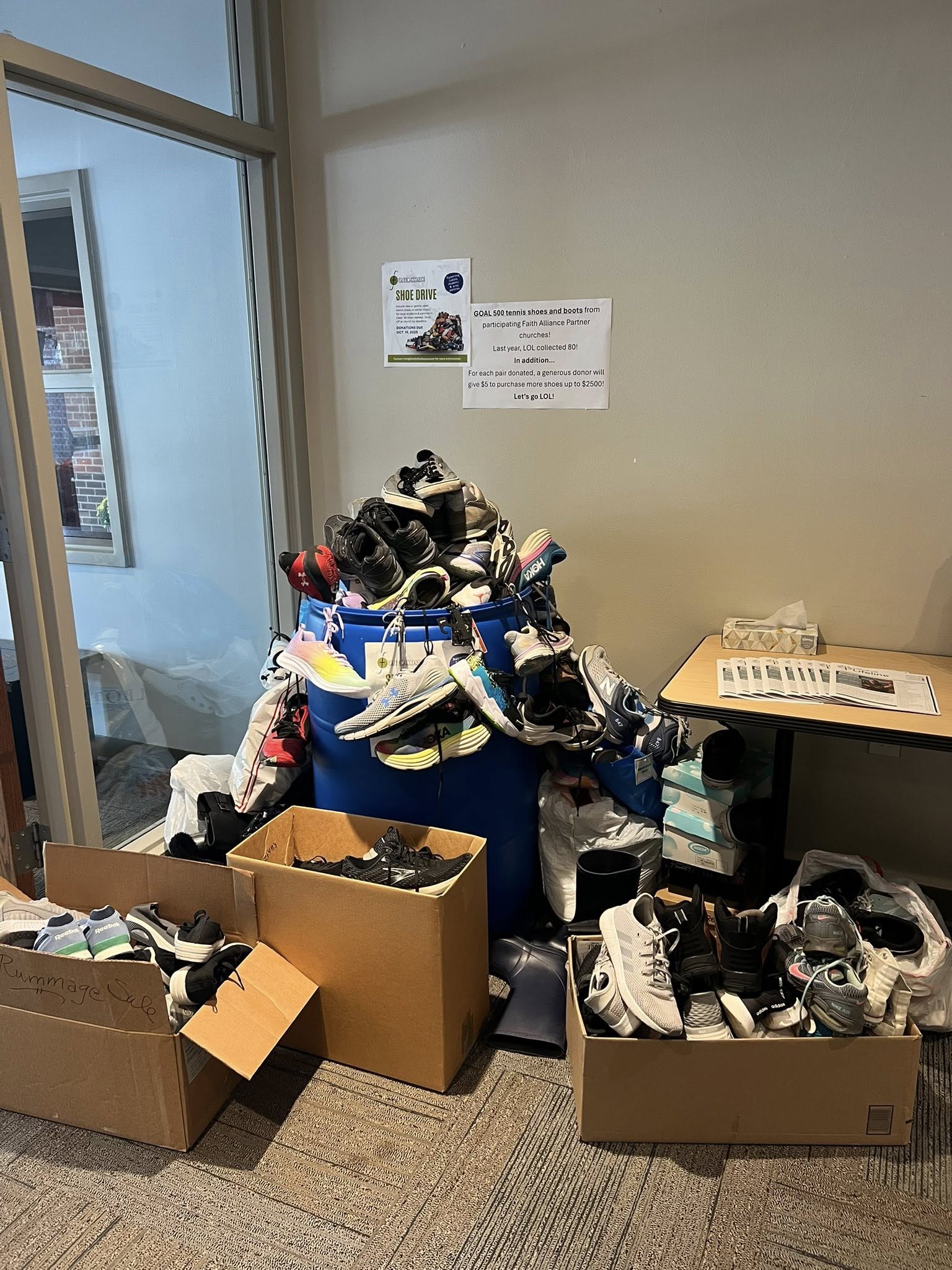
This past month, we encountered a young man who was attending a self-help program at Lord of Life. He had hopes for a new start in life and was lamenting that he couldn’t afford a pair of work shoes that were critical to getting started at his new job. In addition, we had an unhoused person who came to LOL looking for assistance. The blue barrel overflowing with shoes gave hope to both. Digging through the shoes, we found a pair that could minimally be called work shoes that didn’t quite fit, but the young man was thrilled with the find. Unfortunately, even though our mound of shoes was huge, we were unable to find a pair that fit the other person. However, we were able to assist him in securing a place to sleep for a night and provided some additional monetary and food help.
The pile of shoes that we recently gathered as part of The Faith Alliance collection has been a reminder of how critical shoes can be both physically and metaphorically in acting justly, loving kindness, and walking humbly with God (Micah 6:8). They can provide dignity, protection, comfort, and even joy to youth and “God moments” to others in our community who feel the crushing stigma of poverty and hopelessness with insurmountable circumstances in their daily lives. A new pair of shoes and people who recognize their humanity can lead to confidence, hope, and a new lease on life.
This fall has been incredibly busy at LOL with us stretching ourselves to live generously and working together for the good of the community. I pray that the huge pile of shoes will stay in our memory as a reminder of the goodness we can do together with God’s help and guidance. Or that each time we look at our own shoes or our well-stocked closet, we can find empathy, kindness, and generous hearts for others who find themselves without the dignity, comfort, and peace that even one pair of shoes can bring.
Where is God leading you next to act justly, love kindness, and walk humbly with God? How can we support each other in being the heart and “sole” to uplift others up as the constant love of Jesus Christ lifts and sustains us daily?
Walking with you in God’s grace and peace,
Angie Seiller, Director of Faith Formation
P.S. We collected 182 pairs of shoes to add to the other 416 collected by the other churches in Faith Alliance for a total of 598 pairs! A generous donor also pledged $5/pair (up to $2500) for even more new shoe purchases!

With temperatures dropping, I’ve enjoyed spending time in my garden the last couple weeks. I’ve reshaped some flower beds, gotten rid of weeds that have crept in over the last year, and planted a bunch of new flowers for the bees, hummingbirds, and butterflies that come to visit.
If you’ve gardened in southwest Ohio, you know that as soon as your shovel gets through the first couple inches of soil, you hit clay, which is the result of thousands of years of glacial movement leaving fine silt behind. My trowel hits the clay with a dull thud, and I pry up a shovelful of thick, goopy, yellow mess that doesn’t drain and won’t provide the right nutrients for the plants I want in my garden. So I’ve spent countless hours digging out and amending my garden beds to make them more hospitable for the ecosystem I want to create in my yard.
Of course, while I’m toiling away in the dirt, my mind is wandering and eventually it presents to me this quandary: Over and over again in scripture, we’re reminded not to focus on earthly things; that we should set our minds to things of heaven.
Well, shoot. I really like my garden. Am I supposed to let the weeds take over and not worry about keeping it nice? The township might have an issue if I let it get overgrown. I continued to dig in the dirt while I pondered my spiritual dilemma. This great weather won’t last forever.
My train of thought led me to some deep truths about how some Christians interpret the Bible. There are groups of people who are really focused on heaven and how to get there. These “salvation at all costs” folks are quick to identify sins in others and either try to help them “see the light” or cast them out of their social circles for being sinners. This is not what Jesus meant when he said to focus on heavenly things. As a matter of fact, he was pretty specific about loving everybody, whether they are sinners or not; whether they are “unclean” or not. He didn’t say to love them “as long as they start acting the way I think they should.”
We’re left with a Gospel that asks us to bring the joy of salvation here, on earth, in the present. “On earth as it is in heaven,” right? It seems like a big task. With so many difficult things going on in the world, how can any of us make a difference? In my garden, I have added nutrients and organic matter to the clay slowly over years to make it better for my plants to thrive. In our lives, we can strive to be the loving, healthy space for other people to live and grow. That’s how we can focus on heavenly things while maintaining our connection to the physical world.
What are some ways you can bring the joy of God’s love to other people and creation?
Blessings,
John Johns, Music Director
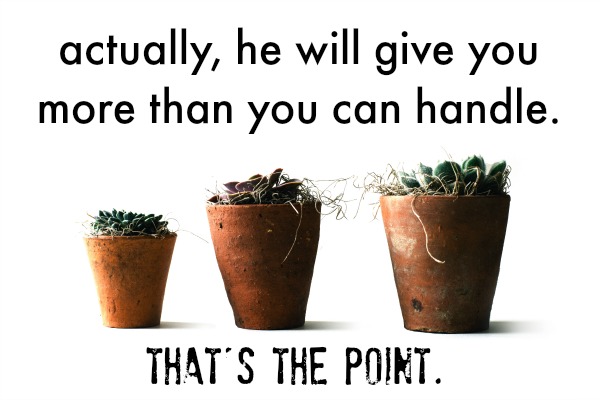
“God only gives you as much as you can handle.”
Growing up, I heard this phrase more times than I could count. I would get stressed and overwhelmed about all the things happening in life, and my mom would always say, “God only gives you as much as you can handle.”
Last week had been a hectic week with a sick kid, my new administrator training, family visiting, a friend in need, what felt like one million activities for my three daughters, a surprise 2-hour delay of school, two upcoming preschool field trips, and, to top it off, my husband was on another work trip. I was sitting at gymnastics watching my younger two girls practice while helping my older daughter with homework while simultaneously trying to respond to a parent email. That’s when THE TEXT came: My husband's flight was delayed AGAIN, and he now would be staying in an airport hotel overnight. I quickly switched tabs on my computer to look at our family calendar for Friday. I now have to figure out how to get my middle daughter to school, my oldest to a doctor appointment, and my youngest to school at the exact same time. Not to mention that we now have two teachers out sick, so I will need to be substituting also at the same time. Thoughts are racing in my head when my oldest daughter says, “Don’t forget that tonight we need to get my costume together for the school walkathon tomorrow” (which is something one of us parents always stops in to watch). Then, the next text that comes in tells me that my after-school care plan for my youngest has fallen through. Now my phone dings again. It’s my husband reminding me our van is done at the shop, and it has to be picked up and the rental car dropped off by 5 p.m. tomorrow. Slowly but surely, I felt like I was melting into a puddle in the lobby of the gymnastics center.
After taking a deep breath, I reached out to a few friends, fixed my transportation woes, and moved the doctors appointment. I crossed my fingers that my husband's plane would land in time for him to visit at least one of the girls at the walkathon while planning how I might squeeze in a visit to the other. I went to bed stressed and overwhelmed with what felt like a neverending week but said to myself, “God only gives you as much as you can handle.” In the morning, I got all the girls on their way and rushed to work only to realize I had forgotten my coffee. I ran to the library to use the Keurig before heading into the classroom. I started to make my coffee when someone needed me. I took care of the need and headed back to pour the water into the Keurig. As I poured the cup of water in the machine, the water began overflowing everywhere. As you can guess, I had already filled the water reservoir on my first attempt to rectify the no caffeine situation. I was frantically cleaning up the spilled water when I stopped and said, “Okay, God, I hear you. Are you saying you sometimes give me more than I can handle? Sometimes, life’s stressors will overflow?”
I think that is exactly what God was telling me. After a short google search, I found that the saying “God gives you as much as you can handle” comes from 1 Corinthians 10:13: “No testing has overtaken you that is not common to everyone. God is faithful, and he will not let you be tested beyond your strength, but with the testing he will also provide the way out so that you may be able to endure it.” Meaning yes, God will give me more than I can handle, but with him, I will find the strength to endure and get through anything that may come my way. Now I lead into this week with a new mantra: “God doesn’t give us what we can handle. God helps us handle what we are given.”
Getting my strength from God,
Nicole Wells
Everything is in motion for mission this week at Lord of Life.
One of our newest members has been trying to figure out how she wants to plug into ministry at Lord of Life. Standing with her in the gathering space after worship recently, she flipped through the Lifeline newsletter and said, “There’s just so much going on. How do I choose?” She’s reviewing her calendar, hoping to make room for a Bible study or serving opportunity as she eases into community here.
All week long, there has been a flurry of volunteers unloading, sorting, and pricing items as they come in for our annual rummage sale – our largest youth and mission fundraiser of the year. What a delight to see a variety of ages from different Sunday morning services interacting and connecting, while sifting through kitchen items, sporting goods, books and movies, furniture, toys, and a myriad of other treasures.
Everyone is adapting. Because rummage sale tables have claimed many of the common areas, preschool children have had to wind through the corridors to their classrooms in new ways. 12-step programs and Scout groups have been meeting in different spaces than usual. Our Wednesday morning Bible study met while encircled by wicker patio furniture, dressers, and bicycles. Shifts in our patterns can help us experience life differently.
Another exciting shift is happening! Following the earlier-than-expected departure of our seminary intern in August, I wondered how we would cover all the pastoral duties of our growing congregation. I am thrilled to announce that this Sunday, we’ll welcome Pastor Tracy Paschke-Johannes in worship, but she isn’t only here for a guest preaching spot. This former campus pastor at Wittenberg University in Springfield will be joining us on a part-time basis while she is in between ministry calls. During the coming months, Pastor Tracy will be filling her time with preaching and teaching at various churches, writing projects, and other creative endeavors.
We are excited that Pastor Tracy has agreed to be with us two Sundays a month, leading worship and teaching as part of Sunday morning learning. In addition, she will be helping lead Bible studies and take part in pastoral care in hospitals, rehab centers, and home visits. We’ll be using funds available from the seminary intern account to cover Pastor Tracy’s compensation.
Pastor Tracy preached at Lord of Life on Reformation Sunday in 2023, just as we were finishing up our Share the Light campaign and construction of The Point and additional spaces. She’ll be preaching again on Sunday, October 12 at all services.
In addition to her most recent time serving as campus pastor, Tracy has served as parish pastor, hospice chaplain, university professor, and more!
In his letter of encouragement to the followers of Jesus in Rome, the apostle Paul writes, “Do not be conformed to this age, but be transformed by the renewing of the mind, so that you may discern what is the will of God” (Romans 12:2 NRSVUE).
While violence and fear swirl around us, I pray that the Holy Spirit will continue to shape our hearts, minds, and lives to the patterns of Jesus, shifting our mindsets to a vibrant community seeking to love God and neighbor with our whole being. Thank you for being a powerful force of God’s presence. You are changing the world.
Come Lord Jesus,
Pastor Lowell Michelson
Picture these three concurrent stories:
A story from the piano:
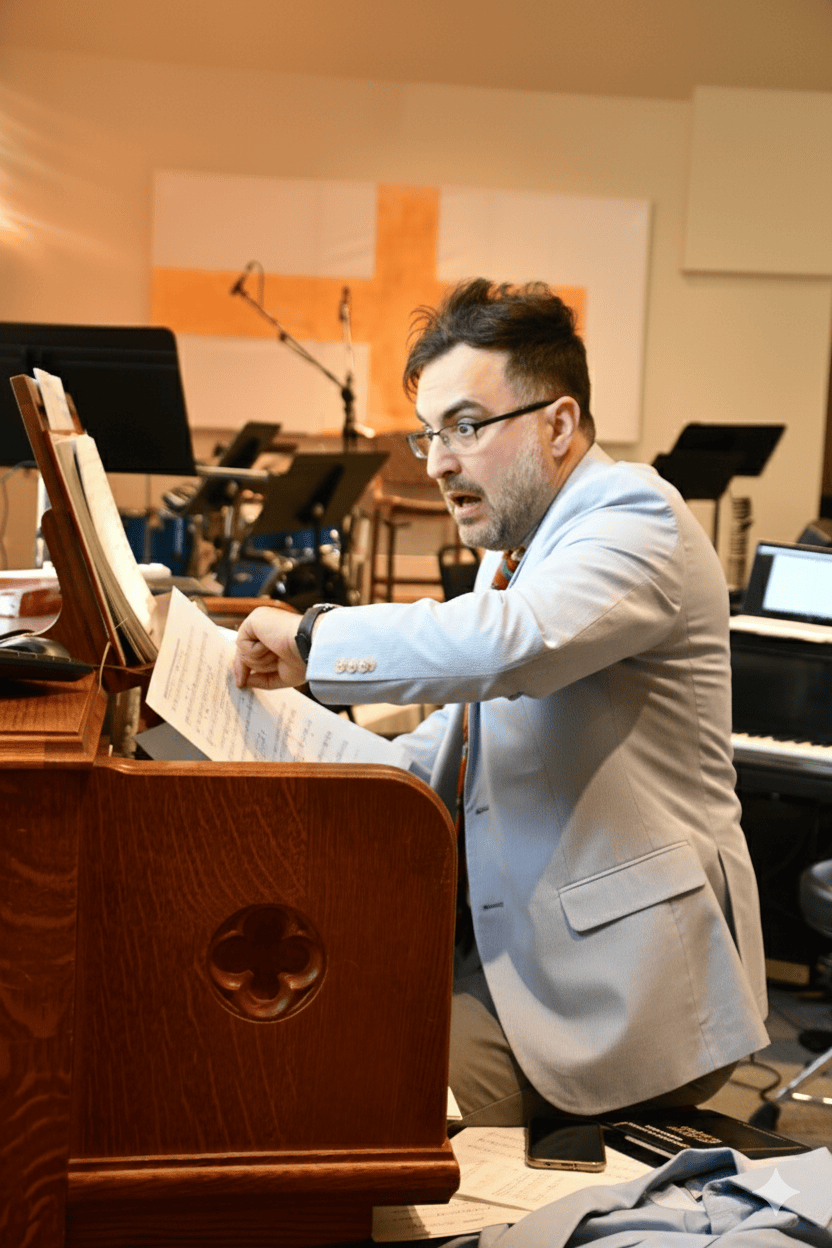
It is 9:05 am on Sunday morning. I’m at the piano warming up the band before worship. We are touching up the music we rehearsed on Thursday night and letting the people who weren’t at practice know what we changed. Someone was supposed to sing a solo in one of the songs, but they are sick this morning, so someone else needs to learn it. It is an important time for us. As I’m finishing with the band at 9:22, the slide-clicker asks me some questions about the slides. We really try to make sure everything is right in the slides for both the people in the building and the people online. It has taken years for us to get things to run as smoothly as they do.
At 9:25, I’m finishing with the slide clicker and am going to head to the piano to get ready for the prelude. I look over and realize we don’t have anyone to run the cameras. I look into the congregation to see who might be available, but as I walk toward someone, another parishioner stops me to show me what their daughter just learned to play on the piano. I love hearing about everyone’s musical progress. But now it is 9:27 and if I don’t start the prelude now, everything else will run late and we have another service at 11, so we can’t afford a delay.
A story from The Point:
It is 9:05 am on Sunday morning. Angie is in The Point getting ready to teach the Junior High Learning Hour. She plugs in her laptop to display on the TVs, gets her notes out, and heads down the hall at 9:15 to make sure the other Sunday School teachers are ready to teach younger kids. Since Children’s Choir is rehearsing after Sunday School and Worship, she makes sure the keyboard is set up in Room C. At 9:25, on her way back toward The Point, she passes the sanctuary where someone tells her we don’t have a lay assistant yet, and we don’t have enough communion assistants. There are plenty of people who have told her they will help if she asks, but teenagers are showing up for class and she really needs to greet them and manage the classroom.
A story from the gathering space:
It is 9:05 am on Sunday morning. Lowell is in the gathering space chatting with 8 am worshipers as they head to breakfast. His sermon went well, but there are some things he wants to tweak. At 9:15 he heads to his office so he can make a few minor adjustments. At 9:22 he puts his new sermon notes at his chair in the worship space and goes back to the gathering area to say “hello” to some incoming 9:30 worshipers. He spots two guests who have never been at LOL before. He makes a point to excuse himself from the folks he knows and greets the worship guests personally. At 9:29 he heads to his seat and realizes there isn’t a lay assistant. He doesn’t even know yet that we’re also short communion assistants and a camera operator. He doesn’t have time to do anything about it, so he hopes someone sees the need and steps up or he’ll just do all the reading and leading himself. A few minutes into worship he sees John going back and forth from the piano to the media desk and realizes he is running cameras when he isn’t playing music.
The view from the pew:
It looks like everything is going fine. Mary Catherine has no idea we’re missing any volunteers and thinks Lowell is doing a great job leading. She doesn’t know why John keeps going behind the media desk. She is a great volunteer, but no one has let her know there is a need.
What can Mary Catherine, and all of you, do to help?
Sign up to volunteer early. We know your schedules are busy and sometimes it’s hard to know when you’ll be at church. But if you can put yourself on the schedule now, just let us know if something comes up and you can’t make it, or ask someone else to fill in for you. We are so grateful for all of our volunteers. You not only make our jobs easier, but you make worship more meaningful for everyone.
To sign up, go to: www.lol-lutheran.ccbchurch.com/goto/scheduling/individuals/ and click the “browse open positions” tab. You’ll be able to click the “accept” button to put yourself on the schedule for any positions that you have filled in the past. If you don’t see any available positions, let us know and we’ll add you to one of the volunteer teams so you can sign up. We are blessed to have all of you with your abundance of gifts. Thank you for stepping up to do God’s work!
Serving with you,
John Johns, Director of Music

The building was buzzing with activity, and we jumped back into three services on Kick Off Sunday this past week. Our theme this year for faith formation and all our ministries together is from Micah 6:8 where the prophet Micah says that the Lord requires us to do justice, love kindness, and walk humbly with God. The children’s message challenged us to stretch ourselves in these loving acts of faithfulness in the coming year.
I thought it might take time to warm up, but I already saw stretching on day one! We had new families sign up to help in Sunday school. They are just learning about us, and yet they jumped right in. We had parents of high school kids who stayed after class to dream about investing in and creating a safe place for our oldest youth to come each Sunday morning. Others were asking about our mid-week discussions and studies that are ramping back up because they were feeling called to learn more. Our Fellowship MAC (Ministry Area Coordinator) was already making plans to shop for hotdogs for Songs and S’mores this Sunday after just doling out hundreds of donuts all morning. Being in community and building relationships fuels our ability to stretch ourselves into taking action.
We also know that life can pull us in countless directions. If you need to stretch yourself into a sanctuary chair or your couch while watching online to refuel your soul, we welcome that too. That is the beauty of God’s community. When one needs the peace of quiet reflection and walking with God, others step in to lift and serve the others. We are bound together by God’s unending love and grace that inspires us to do justice, love kindness, and walk humbly with God.
Where do you see yourself stretching in the coming year in the words of Micah 6:8? Feel free to reach out to me with questions about ways to do life together at Lord of Life that do justice, love kindness, and walk humbly with God. Our website and the monthly Lifeline publication are also great resources. I can’t wait to walk with you on the journey.
Living, sharing, and celebrating God’s love in Jesus Christ with you,
Angie Seiller, Director of Faith Formation

For almost two years, we’ve been searching for a name for the new space on the front lawn. During construction, as the space was taking shape, we asked for name suggestions. While we had dozens of submissions, none of them seemed like the right fit for the addition.
As we began to use and embrace the new space, living into how we would use it and be shaped by this multi-purpose community room, we asked once again for suggestions, and while there were several great ideas, none landed as the perfect name.
In a group text among staff a few weeks ago, Cara Hasselbeck dropped an idea: “What about The Point?” Immediately, I thought, “Yes! Perfect!” The Point encompasses who we are, why we do what we do, and who we are called to be!
The towering peak and prominent cross are architecturally compelling and offer a point of curiosity and invitation to the community. They are the visual entry point for most of the people who come to our campus for worship, learning, serving, and a host of other events and encounters. We fill the room most days of the week with Bible and book studies, Jr High Sunday mornings, quilters, Yarn Benders, and other Lord of Life activities, not to mention Sunday morning worship for Vida Eterna Iglesia Luthera (VEIL), 12-Step meetings, area clergy gatherings, and a whole host of other congregational and community events. This vibrant space is a gathering point for us and so many other groups who encounter faith, hope, and love here.
In addition, if you haven’t noticed, the whole structure is a giant arrow pointing upward. The soaring steeple literally points to something beyond ourselves and the empty cross of Jesus reminds all that love is stronger than death. Sitting in the space, the towering glass keeps our eyes fixed on the world beyond our walls and the jagged design points us out into the community and world.
Sometimes, we ask ourselves, “What’s the point? Why are we striving to live and love like Jesus?” Reflecting on this, I’m reminded of Paul’s powerful and clarifying words in Romans as he tries to get to the point of his letter and summarize how the Spirit of God calls us live:
“Love must be sincere. Hate what is evil; cling to what is good.
Be devoted to one another in love. Honor one another above yourselves…
Be joyful in hope, patient in affliction, faithful in prayer.
Share with the Lord’s people who are in need. Practice hospitality.
Bless those who persecute you; bless and do not curse.
Rejoice with those who rejoice; mourn with those who mourn.
Live in harmony with one another…
Do not repay anyone evil for evil. Be careful to do what is right in the eyes of everyone.
If it is possible, as far as it depends on you, live at peace with everyone…
‘If your enemy is hungry, feed [them]; if [they are] thirsty, give [them] something to drink…”
Do not be overcome by evil, but overcome evil with good.”
Romans 12:9-21 NIV
In 1943, during a speech about rebuilding the House of Commons following its destruction in the Blitz, Winston Churchill commented, "We shape our buildings; thereafter they shape us." May our Lord of Life spaces continue to shape us as people of Christian faith, pointing us to Jesus, our neighbors, and beyond!
Longing to be shaped by God,
Pastor Lowell